
Summary
- Longer articles do not automatically rank higher on Google Singapore because word count is not a direct ranking factor.
- Search intent helps determine whether readers need a short explanation or a comprehensive guide.
- Comparing content length fairly requires accounting for topic, page type and competition.
- Shorter pages can perform well when they provide complete answers without unnecessary explanations.
- Content quality, relevance, originality and technical SEO matter more than reaching a particular word count.
Longer articles do not necessarily rank better in Singapore searches. Google does not prescribe an ideal word count for SEO. Rankings depend on several factors, including content relevance, quality and how effectively a page satisfies search intent.
Still, many Singapore businesses assume that publishing 2,000-word articles gives them an advantage over competitors writing 800 words. This can lead to lengthy blog posts that repeat information without adding much value.
So, does SEO content length in Singapore influence search performance, and when is writing more worthwhile?
Does Google Prefer Longer Articles?
No. Google has explicitly stated that content length alone does not determine rankings. There is no specific word count that guarantees better visibility.
According to Google’s SEO Starter Guide, there is no magical minimum or maximum content length for ranking purposes.
Longer articles can perform well, but their word count is not necessarily the reason.
For example, consider two articles targeting “how to register a business in Singapore”.
One contains 600 words explaining the registration process. Another contains 1,800 words covering ACRA requirements, business structures, registration procedures and common mistakes.
The longer article may be more useful because it addresses additional questions. However, if those explanations are repetitive or irrelevant, the extra words offer little benefit.
Why Do Longer Articles Sometimes Rank Well?
Long-form SEO content offers several potential advantages:
- Broader topic coverage: More space to explain complex subjects and answer related questions.
- Greater contextual detail: Opportunities to clarify terminology, processes and exceptions.
- More useful information: Room for examples, comparisons and supporting evidence.
- Additional search query relevance: Comprehensive articles may naturally address several related searches.
These advantages come from the information provided, not the number of words.
A 2,500-word article may perform poorly if readers only need a straightforward answer. Meanwhile, a focused 700-word explanation could satisfy the same query more efficiently.
Read More: Singapore SME Search Trends: What Businesses Need
How Was Content Length Compared Fairly?
A fair SEO content length comparison examines pages targeting the same search intent and content format, rather than comparing unrelated articles based on word count alone.
For Singapore businesses, this means evaluating local search results instead of relying entirely on international SEO studies.
Comparison Factor | Why It Matters |
Search intent | Different queries require different levels of detail |
Content format | Guides, definitions and service pages serve different purposes |
Website authority | Established websites may have stronger link signals and other ranking advantages unrelated to content length |
Topic coverage | Longer pages may address more relevant questions |
Search location | Singapore results may differ from international results |
Why Average Word Count Can Be Misleading
Imagine analysing five pages ranking for the same Singapore search query.
Page | Word Count | Position |
A | 750 | 1 |
B | 1,200 | 2 |
C | 2,400 | 3 |
D | 1,800 | 4 |
E | 1,350 | 5 |
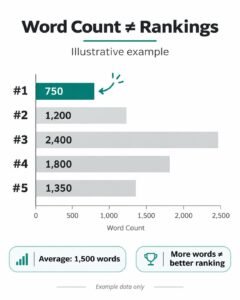
Note: These figures are illustrative, not actual Google Singapore ranking data.
The average word count would be:
(750 + 1,200 + 2,400 + 1,800 + 1,350) ÷ 5 = 1,500 words
A business might interpret this as evidence that its article should contain approximately 1,500 words.
However, the highest-ranking page contains only 750 words, while the longest page ranks third.
This demonstrates why average word count alone cannot establish a relationship between article length and rankings.
Even with actual ranking data, factors such as backlinks, website authority and content relevance must be considered.
How to Compare Singapore Search Results
Businesses can follow a structured process:
- Choose a specific keyword and review Google Search results for Singapore, keeping the location, language and search conditions consistent when comparing pages.
- Identify five to ten relevant organic results with matching search intent.
- Separate informational articles from service and product pages.
- Count the main article content consistently, excluding navigation and footers.
- Compare each page’s ranking, content length and topic coverage.
- Identify which pages answer the search query most completely.
Instead of searching for a winning word count, examine what better-performing articles provide.
Do they include original examples, Singapore-specific information or answers that competing pages overlook?
Remember that SERP comparisons show associations, not proof that changing word count will improve rankings.
Where Do Shorter Pages Perform Better?
Shorter pages can perform well for searches requiring a specific answer, straightforward instructions or a limited comparison.
The important question is whether the page answers the user’s query sufficiently.
1. Simple Informational Searches
Consider someone searching for “what is a meta description”.
The reader wants to understand what a meta description is, where it appears and how to write one.
A concise article covering these points may be more useful than a 2,000-word guide discussing unrelated SEO concepts.
An article does not need to be lengthy simply because the broader subject is complex.
2. Local and Transactional Searches
Searches with local or transactional intent often require information that supports an immediate decision.
For example, someone searching for “corporate tax rate Singapore” may want the current rate, applicable conditions and official guidance.
Similarly, a customer searching for “aircon servicing price Singapore” may benefit more from a clear pricing table and service inclusions than a lengthy explanation of how air conditioners work.
In both cases, relevant information should take priority over article length.
3. Narrow Technical Questions
Some technical searches require precise instructions rather than broad explanations.
Examples include:
- How to submit a sitemap in Google Search Console.
- How to add a canonical tag in WordPress.
- What HTTP status code 301 means.
- How to check whether a page is indexed.
These topics can be covered in relatively short articles.
However, a broader subject such as “how to perform a technical SEO audit” would require substantially more detail.
When Is Longer Content Better?
Longer articles are worthwhile when readers need multiple explanations before making a decision.
For example, a Singapore business comparing SEO agencies may need information about services, deliverables, pricing structures and contract considerations.
Likewise, a comprehensive GST registration guide may need to explain eligibility, procedures, exceptions and ongoing obligations.
Content Type | Recommended Approach |
Quick definitions | Short, direct explanations |
Narrow how-to articles | Focused instructions |
Local service enquiries | Essential details and decision information |
Product or service comparisons | Moderate depth with comparison tables |
Comprehensive guides | Longer content covering related questions |
These are editorial recommendations, not fixed Google ranking rules.
What Matters More Than Word Count?
Search intent, originality, relevance, content structure and page usability matter more than a predetermined article length.
Google’s guidance on creating helpful, reliable, people-first content encourages publishers to consider whether readers receive a satisfying answer and whether the content provides meaningful value.
1. Matching Search Intent
Search intent explains why someone performs a search.
For example:
- “What is SEO?” suggests a need for introductory information.
- “How to improve SEO rankings” suggests actionable guidance.
- “Best SEO agency Singapore” suggests commercial comparison.
- “SEO agency pricing Singapore” suggests a need for cost information.
Although these searches concern the same industry, they require different content structures.
A 3,000-word educational article will not necessarily satisfy someone looking for a service quotation.
2. Providing Original and Useful Information
SEO content should contribute something beyond what competing pages already explain.
For Singapore businesses, this could include:
- Examples reflecting local business conditions.
- References to relevant Singapore regulations.
- Original comparisons or practical demonstrations.
- Clear explanations of common problems.
- Industry-specific recommendations supported by evidence.
For example, an article about e-commerce payments in Singapore could compare payment options, merchant considerations and checkout requirements.
That information is more useful than repeatedly explaining that online payments are convenient.
3. Organising Information Clearly
Even a well-researched article becomes difficult to use when important answers are buried in lengthy paragraphs.
Effective SEO content writing and content marketing should include descriptive headings, concise explanations and tables where necessary.
Longer articles can also provide an introductory summary so readers quickly identify the information they need.
4. Maintaining Technical SEO Fundamentals
Article length cannot compensate for major technical problems.
Businesses should ensure important pages are accessible to search engines, internal links are crawlable and the website works properly on mobile devices.
Loading performance, page usability and accessible content also deserve attention regardless of whether an article contains 500 or 3,000 words.
How Long Should SEO Articles Be in Singapore?
Singapore businesses should determine article length according to search intent, competing content and the information needed to answer the topic properly.
There is no verified Singapore-specific word count that consistently produces better rankings across industries.
However, flexible editorial ranges can help businesses plan content production.
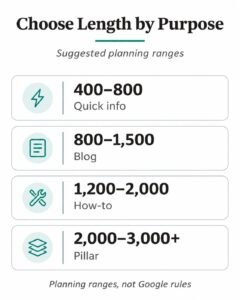
Note: These are suggested writing ranges, not measured Singapore SERP averages or Google ranking thresholds.
Consider a Singapore accounting firm preparing two articles.
The first targets “what is a financial year end”. A focused explanation may answer the query without extensive detail.
The second targets “guide to starting a company in Singapore”. This subject involves multiple business decisions and registration requirements, making a longer guide more appropriate.
Instead of assigning both articles a 1,500-word target, the firm should prepare outlines based on readers’ questions.
The right content length is the amount needed to deliver a complete answer without unnecessary filler.
Should Businesses Expand Existing Articles to Improve Rankings?
Expanding an article makes sense when important information is missing, outdated or insufficiently explained.
Before revising content, businesses should examine its performance using Google Search Console.
A practical review involves:
- Identify underperforming articles. Find pages receiving relevant impressions but limited organic clicks.
- Review search queries. Check whether the article answers what people are searching for.
- Compare competing pages. Identify useful information the article may be missing.
- Improve content selectively. Add relevant explanations, examples or updated information.
- Measure performance. Compare results across suitable periods while accounting for seasonal changes.
For example, suppose an 850-word article about accounting software receives impressions for queries about pricing and integration features.
If the article does not address those subjects, adding a comparison section could make it more useful.
However, if the page already answers its target queries thoroughly, increasing its length may offer little benefit.
When Should You Shorten an Article Instead?
Reducing content can be worthwhile when an article contains repeated explanations, outdated information or irrelevant sections.
For example, a 2,500-word SEO article might explain the importance of keywords in several different sections.
Removing repetition could improve readability without sacrificing useful information.
Before shortening an article, verify that important explanations supporting relevant search queries are not being removed.
Longer Content Is Not Always Better
Longer articles can perform well in Singapore searches when additional depth genuinely helps readers. However, word count alone does not determine rankings, and shorter articles can be equally effective for focused queries.
Businesses should prioritise relevant answers, original information and clear content structure before increasing article length.
At SEO Agency Singapore, we help businesses evaluate their content strategies based on search intent and actual performance rather than arbitrary word counts. Our SEO services focus on identifying content gaps, improving existing pages and developing articles that support sustainable organic visibility.
Frequently Asked Questions
Is 500 Words Enough for SEO in Singapore?
Yes. A 500-word article can rank if it answers a focused search query effectively. However, complex topics may require more detail. Google does not impose a minimum word count for rankings.
Is 2,000 Words Too Long for a Blog Post?
Not necessarily. A 2,000-word article is appropriate when the subject requires detailed explanations, comparisons or practical guidance. Additional content should provide useful information rather than repeat existing points.
Does Google Penalise Short Articles?
Google does not impose a ranking penalty based solely on a low word count. However, short articles may struggle to rank if they lack useful information or original value. The issue is content quality, not length.
Can Adding More Words Improve SEO Rankings?
Adding words can help when they address relevant search queries or improve incomplete explanations. However, increasing article length without improving usefulness does not guarantee higher rankings.
Should Every Blog Have the Same Word Count?
No. Each article should have a length appropriate to its topic and search intent. Applying identical word counts to definitions, tutorials and comprehensive guides can create unnecessary content.
How Often Should Businesses Review Their SEO Content?
A quarterly review is a practical starting point, with more frequent checks for important or rapidly changing topics. Prioritise articles experiencing ranking declines, outdated information or changing search demand.