Summary
- Seasonal events influence what Singaporeans search for, when they search and how quickly they make purchasing decisions.
- Chinese New Year, Hari Raya, school holidays and year-end sales create different search opportunities.
- Search demand can increase weeks before an event, making early SEO preparation important.
- Google Trends and Google Search Console help businesses identify seasonal patterns and measure performance.
- Successful seasonal SEO focuses on relevant keywords, timely content and actual business results.
Seasonal events in Singapore change search demand by influencing what people need, when they search and how urgently they make purchasing decisions. Festivities, school holidays, shopping campaigns and major events can all increase interest in particular products and services.
For Singaporean businesses, these changes create opportunities to attract customers at the right time.
Consider a bakery preparing for Chinese New Year, a restaurant promoting Ramadan buffets or a hotel expecting visitors during the Singapore Grand Prix.
Their customers may begin searching weeks or months before the event.
Understanding these patterns helps businesses prepare their seasonal SEO strategies before demand reaches its peak.
Which Seasonal Events Affect Search Demand in Singapore?
Singapore’s search demand is influenced by cultural celebrations, public holidays, shopping campaigns and major international events.
However, each occasion affects businesses differently.
A florist may experience increased interest around Valentine’s Day, while a tuition centre could receive more enquiries before school holidays.
According to Singapore’s Ministry of Manpower, the country has 11 gazetted public holidays in 2026, including Chinese New Year, National Day, Deepavali and Christmas.
Here are several events worth considering when planning SEO services in Singapore.
Seasonal Event | Potential Search Demand | Relevant Businesses |
Chinese New Year | Reunion dinners, hampers, festive gifts | F&B, retail, florists |
Ramadan and Hari Raya | Iftar buffets, halal catering, festive clothing | Restaurants, fashion, catering |
School Holidays | Enrichment camps, family activities, travel | Education, tourism |
National Day | Dining promotions, celebrations, staycations | Retail, F&B, hospitality |
Singapore Grand Prix | Hotels, restaurants, entertainment | Hospitality, tourism |
Deepavali | Festive clothing, decorations, sweets | Retail, F&B |
11.11 and Christmas | Discounts, electronics, gifts, delivery | E-commerce, retail |
Businesses should prioritise occasions that are relevant to their customers rather than creating campaigns for every celebration.
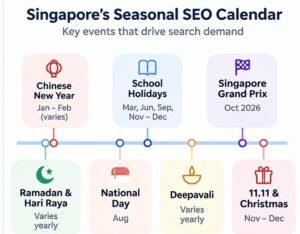
There is also an important difference between public holidays and commercial events.
Chinese New Year and Hari Raya follow calendars that shift relative to the Gregorian year. Meanwhile, shopping campaigns such as 11.11 have fixed dates, although promotions may run for longer.
This means businesses cannot simply reuse the same monthly SEO schedule every year. Their content calendars should account for the actual dates of upcoming celebrations.
How Do Seasonal Events Change Search Behaviour?
Seasonal events affect search volume, keyword intent and purchasing urgency.
More importantly, customers often search differently as an event approaches.
1. Search Volume Changes
Consider a bakery selling pineapple tarts throughout the year.
During ordinary months, customers might search for:
- Pineapple tarts Singapore
- Traditional pastries Singapore
- Best bakery near me
As Chinese New Year approaches, more specific searches may become relevant:
- CNY pineapple tarts Singapore
- Chinese New Year cookies delivery
- Pineapple tarts gift box
- Last-minute CNY goodies
The bakery has not necessarily changed its products. What changes is how customers describe what they want.
Microsoft Advertising’s January 2025 report, based on Lunar New Year 2024 search behaviour, found that searches and clicks across several Southeast Asian markets peaked four to six weeks before the celebration. However, timing varied by category and market.
This is why businesses should examine seasonal keyword variations alongside their existing product keywords.
2. Search Intent Becomes More Specific
Seasonal searches can also reflect different stages of purchasing.
Search Query | Customer Intent | Suitable Content |
Chinese New Year gift ideas | Research | Gift guide |
CNY hamper delivery Singapore | Comparison | Product page |
Same-day CNY hamper delivery | Immediate purchase | Delivery page |
Someone researching gift ideas may still be exploring their options.
Meanwhile, a customer searching for same-day delivery is likely to have a more immediate requirement.
Businesses should create content that answers these different needs instead of directing every visitor to a generic homepage.
For instance, a gift guide can help customers decide what to buy, while a dedicated product page should provide prices, availability and delivery details.
Both pages serve different purposes within the same seasonal campaign.
3. Location Becomes More Important
Certain events encourage location-specific searches.
For example:
- Chinese New Year dinner Orchard
- Halal buffet Marina Bay
- Hotels near Singapore Grand Prix
A restaurant near an event venue could attract relevant searches by providing accurate information about its location, menu, opening hours and reservations.
Location relevance becomes particularly important when customers are looking for immediate services, such as restaurants open during public holidays or shops offering same-day collection.
However, simply mentioning a popular event does not make a website relevant.
Seasonal SEO works best when the occasion, customer intent and business offering are genuinely connected.
Read More: English, Chinese or Malay: Which Language for SEO in Singapore?
When Should Businesses Start Preparing Seasonal SEO?
As a practical starting point, businesses can begin preparing seasonal content around 8–12 weeks before major festive campaigns.
However, the best timing depends on historical search demand, industry competition and how early customers make purchasing decisions.
Hotel guests attending major events may book months in advance, while customers ordering festive meals might make decisions much closer to the date.
A practical seasonal SEO timeline looks like this:
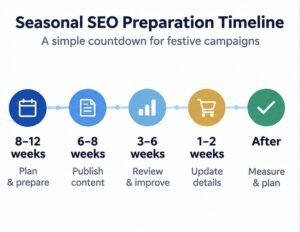
These are suggested planning windows rather than guaranteed search-demand peaks.
Businesses should use their historical search and sales data to determine when customers actually begin looking.
Why Publishing Too Late Can Hurt Seasonal SEO
Unlike paid advertising, organic search visibility is not guaranteed immediately after publishing a page.
Search engines need to discover, crawl and index new content. Even after indexing, a page must compete with other relevant results.
Publishing a festive landing page just days before the occasion may leave insufficient time to attract meaningful organic traffic.
For recurring events, businesses can reduce this risk by maintaining existing seasonal pages and refreshing them well before the next campaign.
How Can Businesses Identify Seasonal Search Trends?
Google Trends and Google Search Console are two useful tools for understanding seasonal demand.
Google Trends
Google Trends allows businesses to compare relative search interest across different periods.
For Singapore-focused research:
- Set the location to Singapore.
- Select the past five years.
- Enter a relevant seasonal keyword.
- Compare related search terms.
- Identify recurring increases in search interest.
For example, a catering company could compare searches for “CNY catering”, “Hari Raya catering” and “corporate catering Singapore”.
Look beyond the highest point on the graph.
The more useful questions are when interest begins increasing, how long the increase lasts and whether similar patterns appear across multiple years.
Google Trends uses sampled, normalised search data on a 0–100 scale. A score of 100 represents peak relative interest within the selected comparison, not 100 searches.
It does not provide exact search volumes, and very low-volume terms may appear as zero.
Google Search Console
Google Search Console helps businesses understand how their websites perform in Google Search.
Important metrics include:
- Impressions: How often links to your website are shown in Google Search results, according to Google’s counting rules.
- Clicks: How many times users click links to your website from Google Search results.
- CTR: The percentage of impressions that result in clicks.
- Average Position: The average position of your website’s topmost result in Google Search for the selected reporting view.
Compare results from similar festive periods across different years.
For celebrations with changing dates, such as Chinese New Year and Hari Raya, compare equivalent periods before the event rather than relying only on calendar months.
Combine Search Data With Customer Enquiries
Search trends become more valuable when they can be connected to business activity.
A catering company might notice that searches for corporate festive packages increase several weeks before actual bookings.
By comparing search data with enquiry records, the company can identify when customers begin researching and when they are ready to confirm orders.
This can help determine when to publish content, launch promotions and prepare staff for increased enquiries.
Read More: How to Optimise Service Pages for AI Search
How Can Singapore Businesses Improve Their Seasonal SEO?
Effective seasonal SEO involves preparing relevant content, maintaining accurate business information and ensuring customers can complete their intended actions.
1. Create Dedicated Seasonal Landing Pages
A restaurant promoting Chinese New Year reunion dinners could create a page explaining:
- Available dining packages
- Prices and menu options
- Reservation requirements
- Seating capacity
- Booking deadlines
These details help customers compare options and make decisions.
A seasonal page should also include an obvious next step, such as making a reservation, requesting a quotation or viewing available products.
Without a clear next step, businesses may attract visitors who leave without taking action.
2. Update Existing Seasonal Pages
Businesses do not need to create new URLs every year.
A bakery could maintain a permanent page such as:
/chinese-new-year-goodies/
Before each festive season, it can update the products, prices, photographs and delivery information.
This keeps the page relevant without creating unnecessary duplicate content.
Businesses should also check that previous years’ promotional banners, expired discounts and outdated ordering deadlines have been removed.
3. Optimise Local Business Information
Businesses should ensure their Google Business Profiles display accurate:
- Opening hours
- Contact details
- Addresses
- Special hours for public holidays
- Booking information
This is especially useful when customers search for nearby businesses during public holidays.
For example, a restaurant remaining open during Chinese New Year should confirm its holiday hours in its Google Business Profile rather than assuming customers will know.
Incorrect holiday information can result in missed enquiries or customers arriving when a business is closed.
4. Connect Seasonal Content With Evergreen Pages
A florist’s Valentine’s Day collection could link to its regular flower delivery page.
Similarly, a restaurant’s festive buffet promotion could direct customers to its permanent reservation page.
This helps visitors find relevant services even after the seasonal campaign ends.
It also supports a more organised website structure, where seasonal promotions complement existing product and service information.
What Does a Seasonal SEO Campaign Look Like?
Consider a hypothetical Singapore bakery preparing for Chinese New Year.
The bakery wants to attract customers looking for festive cookies, gift boxes and corporate hampers.
It begins optimising its website 10 weeks before the celebration.
The business updates its festive landing page, publishes a gift guide and improves delivery information.
After the campaign, it compares organic search performance against the previous season.
Metric | Previous Season | Current Season |
Organic Impressions | 20,000 | 28,000 |
Organic Clicks | 1,200 | 1,820 |
Organic CTR | 6.0% | 6.5% |
Orders Attributed to Organic Search | 36 | 65 |
These figures are hypothetical and are provided only to demonstrate performance measurement.
The increase in organic clicks is calculated as:
(1,820 − 1,200) ÷ 1,200 × 100 = 51.7% increase
The bakery receives more visitors and orders attributed to organic search than during the previous season.
Google Search Console can measure impressions and clicks, while website analytics and order records can help track purchases attributed to organic search.
However, the results do not prove that SEO alone caused the improvement. Promotions, pricing, product availability and other marketing activities may also have contributed.
Businesses should evaluate both search visibility and actual commercial results.
Is Seasonal SEO Suitable for Every Singapore Business?
Seasonal SEO is most useful when an occasion directly influences customer demand.
Retailers, restaurants, hotels, florists and enrichment centres may find clear opportunities around festive periods and school holidays.
However, some B2B businesses experience more consistent demand throughout the year.
For example, an industrial equipment supplier may benefit more from technical product content than Christmas promotions.
Other businesses may have seasonal opportunities that are unrelated to traditional festivities.
An accounting firm might experience increased interest around financial reporting periods, while an events company could attract enquiries ahead of industry conferences.
Before investing in seasonal SEO, businesses should consider:
- Does the event genuinely influence our customers?
- Is there evidence of recurring search demand?
- Can we offer relevant products or services?
- Can we fulfil additional enquiries or orders?
- Will the campaign justify the required resources?
If seasonal interest is limited, improving evergreen SEO content may offer better long-term value.
The goal is not to participate in every major event. It is to identify the periods when customers are most likely to need what the business offers.
Adapting to Seasonal Event Demand
Seasonal events change search demand in Singapore by influencing customer interests, purchasing intentions and the timing of online searches.
Businesses that identify these patterns early can prepare relevant content, improve search visibility and attract customers when demand increases.
For businesses planning their next seasonal campaign, SEO Agency Singapore is a reliable SEO partner that helps improve keyword targeting, website content and organic search performance. Reviewing previous seasonal traffic and identifying upcoming opportunities is a practical place to start.
Sources
- Ministry of Manpower Singapore: Public Holidays for 2026 — June 2025
- Google Trends Help: FAQ About Google Trends Data
- Microsoft Advertising: Lunar New Year Search Trends — January 2025
- Singapore Tourism Board: Grand Prix Season Singapore 2026 — September 2026
- Google Search Console Help: Performance Report
- Google Search Console Help: Impressions, Position and Clicks
- Google Business Profile Help: Set Special Hours
- Google Search Central: Troubleshoot Crawling Errors
- Google Search Central: SEO Starter Guide
- Google Analytics Help: Conversions and Key Events
Frequently Asked Questions About Seasonal SEO in Singapore
What Is Seasonal SEO?
Seasonal SEO involves optimising website content for search demand that changes during specific events or periods. It helps businesses attract customers during festivals, holidays and recurring shopping campaigns.
How Early Should Businesses Start Seasonal SEO?
A useful starting point is 8–12 weeks before a major festive campaign. Businesses with competitive keywords or longer booking cycles may need more time. Use previous search and sales trends to refine your schedule.
Does Chinese New Year Affect Google Searches in Singapore?
Yes. Chinese New Year can increase interest in festive products and services. Relevant searches include reunion dinners, hampers, pineapple tarts and festive clothing.
Can Seasonal SEO Help Small Businesses?
Yes. Small businesses can target relevant seasonal searches with local purchasing intent. Bakeries, florists and restaurants can benefit from optimising their festive products and services.
Should Seasonal Pages Be Deleted After an Event?
No, if the pages will be useful again. Keep relevant URLs and update their content before the next event. Remove expired offers and outdated information.
How Do I Measure Seasonal SEO Performance?
Compare organic clicks, impressions, conversions and enquiries against previous seasons. Google Search Console, website analytics and sales data can help determine whether the campaign delivered meaningful results.