
Summary
- Content refresh SEO can improve existing blog rankings by addressing outdated information, weak search intent and technical issues.
- Articles with declining clicks or relevant queries ranking outside the top results are useful candidates for review.
- Updating titles, headings, internal links and missing information can be more valuable than simply rewriting paragraphs.
- Google can take days or weeks to recrawl updated content, while ranking changes may take longer.
- Organic clicks, impressions, CTR and indexing status help determine whether a refresh is working.
Refreshing old blog posts can improve organic performance when existing content loses relevance, misses important search queries or develops technical issues. However, higher rankings are not guaranteed, and meaningful improvements depend on identifying the right problems before updating an article.
For Singapore businesses with underperforming blogs, content refresh SEO offers an alternative to constantly publishing new articles.
An article that once ranked well may gradually lose traffic as competitors publish stronger resources, information becomes outdated or search behaviour changes. In other cases, a blog post remains valuable but suffers from an unclear title, weak internal linking or indexing problems.
To illustrate the potential of updating blog posts, we’ll examine a hypothetical refresh involving eight articles, covering how they could be selected, what improvements could be made and how organic performance should be measured.
Read More: How Seasonal Events Change Search Demand in Singapore
What Can a Content Refresh Improve?
A content refresh involves updating an existing article to better meet current search intent, improve accuracy and strengthen its SEO performance.
Unlike publishing a new article, refreshing content allows businesses to improve a page that may already have search visibility, backlinks and established relevance.
However, different performance problems require different solutions.
Blog Performance Issue | Recommended Improvement |
Declining organic traffic | Update information and search intent |
High impressions, low CTR | Review search position, intent, title and meta description |
Weak keyword rankings | Address missing topics and questions |
Poor internal linking | Add relevant contextual links |
Not indexed by Google | Investigate technical and content issues |
For example, an older article titled “How Much Does SEO Cost in Singapore?” might contain outdated pricing examples or lack explanations of factors affecting agency fees.
Refreshing the article could introduce clearer cost comparisons, explain different service packages and answer questions Singapore businesses frequently ask before hiring an agency.
Google’s SEO Starter Guide recommends reviewing published content and updating it when necessary, with an emphasis on helpful, reliable information.
The objective is to improve the article’s value to readers, not simply make it appear newly published.
Which Posts Were Selected for the Test?
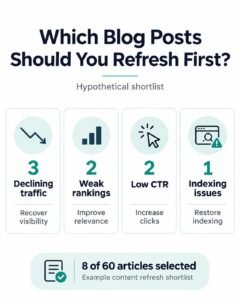
For this hypothetical scenario, imagine a Singapore business reviewing 60 existing blog posts and selecting eight for optimisation.
Rather than choosing the oldest articles, the selection would focus on pages showing measurable search potential or identifiable weaknesses.
Blog Posts With Declining Traffic
An article titled “SEO Tips for Singapore Small Businesses” previously generated consistent organic clicks but gradually lost visibility.
If clicks declined from 180 to 95 over comparable 28-day periods, the decrease would be:
(180 – 95) ÷ 180 × 100 = 47.2%
Such a decline warrants investigation, particularly if impressions and keyword rankings have also fallen.
Possible causes include outdated recommendations, stronger competing articles or changing search demand.
Before refreshing the content, the business should compare historical performance and examine which search queries experienced the largest declines.
Blog Posts With Weak Rankings
Consider “How to Improve Google Rankings for Your Website”, ranking around positions 12 to 18 for relevant searches.
The article already has some visibility but could be missing practical explanations about technical SEO, search intent or indexing.
A targeted refresh could address those gaps.
For example, adding a troubleshooting section explaining why rankings decline may help answer questions that the original article overlooked.
However, ranking position alone should not determine priority. Search demand, business relevance and identifiable content gaps also matter.
Blog Posts With Low CTR
An article titled “Complete Guide to Digital Marketing” might receive 12,000 impressions but only 180 clicks.
Its CTR would be:
180 ÷ 12,000 × 100 = 1.5%
A more specific title, such as “Digital Marketing for Singapore SMEs: Strategies & Costs”, could communicate its relevance more clearly.
The revised title identifies the audience and gives readers a better idea of what the article covers.
However, CTR must be assessed alongside search position and intent. Lower-ranked pages naturally face different click opportunities, so a low CTR does not always indicate a title problem.
Blog Posts With Indexing Problems
An article titled “Why Is My Website Not Showing on Google?” might be excluded from Google’s index.
Before rewriting, the business should investigate canonical tags, noindex directives, duplicate content and crawl accessibility.
If a technical restriction prevents Google from indexing the page, improving the article’s wording alone will not resolve the problem.
Example Article Selection
The hypothetical eight-post shortlist could be organised as follows:
Selection Criteria | Number of Posts | Main Objective |
Declining organic traffic | 3 | Recover lost visibility |
Weak keyword rankings | 2 | Improve search relevance |
High impressions, low CTR | 2 | Increase click potential |
Indexing problems | 1 | Restore index eligibility |
Total | 8 | Targeted optimisation |
This approach makes content refreshing more manageable while directing resources towards articles with identifiable opportunities.
What Changes Were Made Beyond Rewriting?
A meaningful content refresh would involve editorial, on-page and technical improvements based on each article’s weaknesses.
Simply adding more words would not be the objective.
Search Intent and Keyword Optimisation
Existing Search Console queries would be reviewed to identify missing information and relevant secondary keywords.
For example, “How to Improve Google Rankings” could be expanded to explain keyword cannibalisation, internal linking and indexing problems.
The revised article could also include practical examples showing how Singapore businesses identify underperforming pages.
The goal is to answer genuine reader questions without forcing keywords into unrelated sections.
SEO Titles and Headings
Generic headings would be replaced with clearer, more specific alternatives.
For example:
Before: Important SEO Factors
After: What Prevents Singapore Websites From Ranking Higher?
This tells readers what the section covers while improving topical clarity.
Meta descriptions could also be revised to highlight the article’s most useful information.
However, Google can generate its own search snippets, so changes to meta descriptions do not guarantee higher CTR.
Internal Linking and Content Structure
Relevant contextual links would connect supporting blog content or articles, service pages and related resources.
For example, a general article about improving rankings could direct readers to a more detailed explanation of technical SEO.
Long paragraphs could also be shortened, repetitive explanations removed and comparison tables introduced where useful.
These adjustments help readers navigate information without changing the article’s original purpose.
Accuracy and Technical Improvements
Older references, broken links and outdated examples would be corrected.
Technical checks would cover:
- Indexing directives and canonical URLs
- Sitemap inclusion
- Broken internal links
- Page accessibility
- Duplicate or overlapping content
For example, an updated article might contain accurate information but still not appear as a separate search result if Google selects another URL as the canonical version.
In that situation, reviewing the canonical configuration and duplicate content would take priority over further rewriting.
How Quickly Did Search Performance Respond?
Google can take several days to several weeks to recrawl updated content. Ranking improvements may require additional time, depending on the changes and competing search results.
According to Google’s recrawling documentation, requesting indexing does not guarantee immediate inclusion in search results.
For the hypothetical refresh, performance could be monitored over 12 weeks.
Monitoring Period | Main Focus |
Week 1 | Check accessibility, indexing directives and current indexing status |
Weeks 2–4 | Monitor recrawling and impressions |
Weeks 5–8 | Compare clicks, CTR and rankings |
Weeks 9–12 | Evaluate sustained performance |
These are suggested monitoring checkpoints rather than guaranteed ranking timelines. Recrawling and indexing changes should continue to be monitored throughout.
Hypothetical Before-and-After Results
The following figures demonstrate how the eight refreshed articles could be evaluated across comparable 28-day periods.
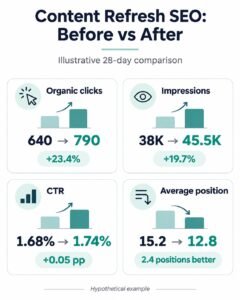
These figures are illustrative and do not represent measured results. CTR changes are calculated before rounding.
For organic clicks:
(790 – 640) ÷ 640 × 100 = 23.4% growth
The example demonstrates how higher search visibility could translate into additional organic traffic.
However, improvements cannot automatically be attributed to the refresh. Search demand, competitors, seasonality and Google algorithm changes can also influence performance.
What Would These Results Actually Tell Us?
The hypothetical increase in impressions suggests that the articles appeared more frequently in Google Search.
Meanwhile, the improvement in organic clicks indicates that more users selected those results.
The modest CTR increase suggests that clicks grew slightly faster than impressions.
Average position improved from 15.2 to 12.8, but this metric should be interpreted carefully. It reflects an average of topmost results across recorded impressions, and changes in the mix of search queries can affect the figure.
A more detailed analysis would examine individual articles rather than relying solely on aggregate performance.
For example, three articles might generate most of the additional clicks while the remaining five show little improvement.
This distinction matters when deciding which optimisation techniques deserve further investment.
How to Measure Results More Reliably
Businesses should compare equal-length reporting periods and account for changes in search demand.
For Singapore-focused websites, filtering Search Console results by country can help isolate local organic performance.
It is also useful to compare refreshed articles against similar pages that were not updated.
If both groups improve significantly, broader market or algorithm changes could be contributing to the results.
This makes the evaluation more credible than assuming every increase was caused by the content refresh.
Should Businesses Refresh Old Blogs or Publish New Content?
Refreshing existing content is useful when an article already targets a valuable topic but contains identifiable weaknesses.
Publishing new content makes more sense when the website has not addressed a distinct search intent.
For example, a Singapore accounting company could refresh an outdated article titled “Guide to Corporate Tax in Singapore” to improve accuracy and clarity.
However, a separate article explaining “Common Corporate Tax Filing Mistakes” could be worthwhile if it answers different reader questions.
Businesses should prioritise:
- Refresh: Existing articles losing visibility or containing outdated information.
- Create: Valuable topics not adequately covered on the website.
- Consolidate: Multiple articles competing for substantially similar searches.
- Monitor: Articles performing well without significant accuracy issues.
Not every old article requires updating.
In fact, rewriting a successful article without a clear reason could remove information that previously satisfied readers.
Before making major changes, review what the existing article already does well.
What If Updated Blog Posts Still Do Not Rank?
A content refresh does not guarantee indexing or higher search rankings.
If an updated article continues underperforming, investigate whether:
- The topic has sufficient search demand.
- The content matches current search intent.
- Competing articles provide more useful information.
- Technical restrictions prevent indexing.
- Other pages on the website target the same queries.
Google Search Console can help identify whether the issue involves declining impressions, lower CTR or indexing exclusions.
Businesses should also avoid repeatedly requesting indexing without addressing the underlying problem.
If an article is technically accessible but still excluded, review whether it provides sufficient original value and whether similar content already exists elsewhere on the website.
When a refreshed article fails to improve, reassess the original problem before making another round of changes.
Improving Your Content to Improve Your Results
Content refreshing and SEO can help Singapore businesses improve existing blog content without relying exclusively on new publications.
The strongest opportunities come from articles with declining traffic, weak rankings, unanswered search queries or fixable technical problems.
Businesses should select articles using actual performance data, make targeted improvements and measure results over comparable periods.
For businesses unsure where to begin, SEO Agency Singapore, your trustworthy SEO agency, can assess existing blog performance and identify articles worth updating. Our SEO services cover content optimisation, technical audits and organic search strategies designed around your business goals.
Sources
- Google Search Central – SEO Starter Guide
- Google Search Central – Creating Helpful, Reliable, People-First Content
- Google Search Central – Ask Google to Recrawl Your URLs
- Google Search Central – Debugging Drops in Google Search Traffic
- Google Search Central – Control Your Snippets in Search Results
- Google Search Central – Canonical URL Documentation
- Google Search Console – Performance Report
- Google Search Central – Influencing Byline Dates in Google Search
Frequently Asked Questions About Updating Old Blog Posts
Does Updating Old Blog Posts Improve SEO?
Yes, when updates improve relevance, accuracy or technical accessibility. However, refreshing content does not guarantee higher rankings.
How Long Does a Content Refresh Take to Work?
Google can take days or weeks to recrawl updated pages. Ranking improvements may take longer, depending on competition and the significance of the changes.
Can Updating Blog Posts Fix Indexing Problems?
Only when the underlying issue is resolved. Check canonical tags, noindex directives, crawl accessibility and content quality before requesting indexing.
Should I Change the Publication Date When Updating a Blog?
Only when substantial changes justify it. Changing the date without meaningful improvements does not automatically increase rankings.
How Often Should Businesses Refresh Their Content?
Review important articles periodically, using a 3–6 month check as a practical internal schedule if appropriate. Update them when information becomes outdated, user needs change or performance data reveals a meaningful opportunity.
Is Content Refreshing Better Than Publishing New Articles?
Both serve different purposes. Refresh existing content with clear improvement potential and publish new articles when targeting distinct, relevant search intent.